Tuesday, December 3, 2024
Introducing Wrkbelt Scheduler: The Online Booking Tool Built for Service Businesses

Your Scheduler Is Bleeding Money (Here's How We Know)
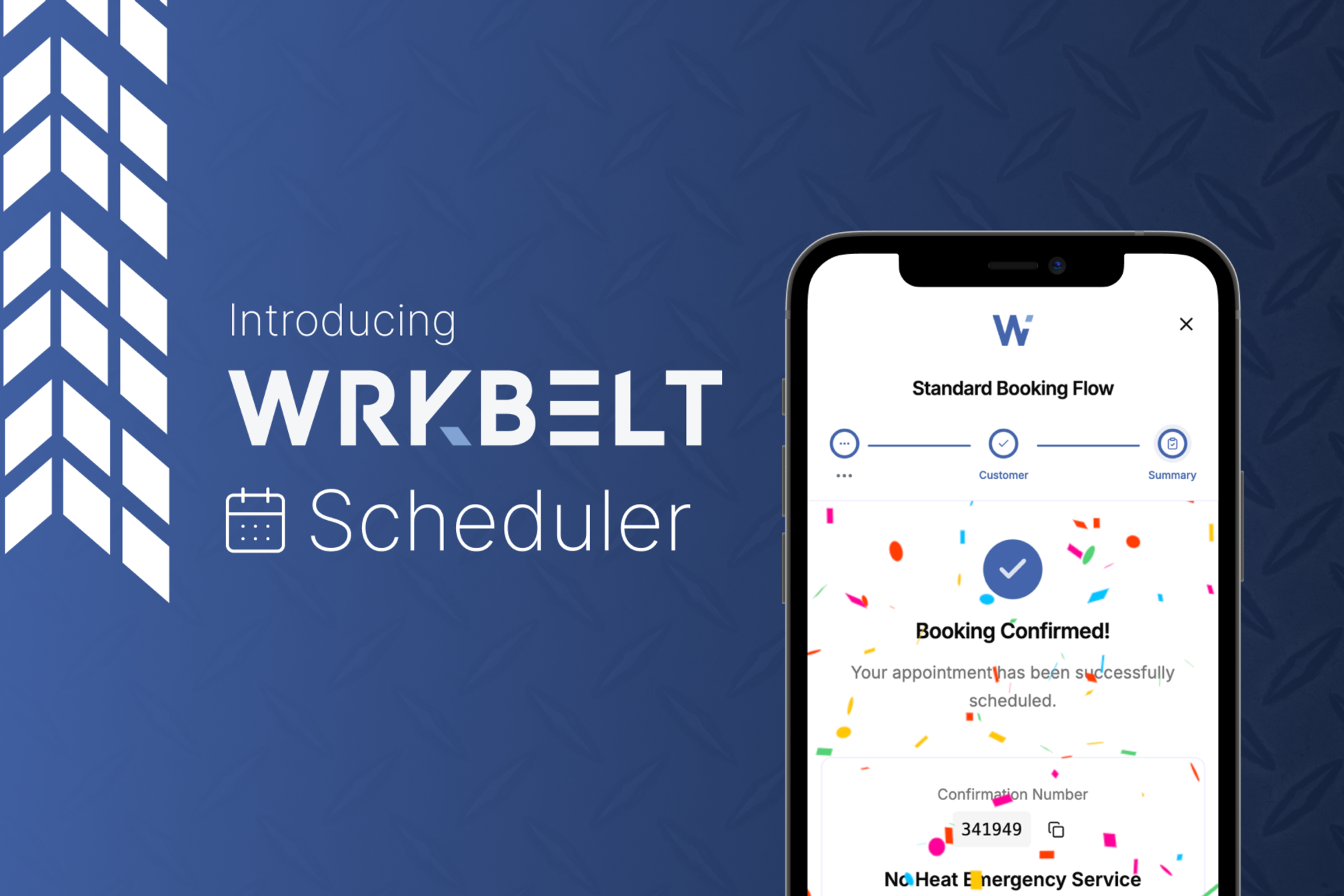
Seven months. That's how long we spent building, testing, breaking, and rebuilding Wrkbelt Scheduler.
Today, it's officially out of beta and available to service businesses everywhere. But this isn't your typical product launch post—mostly because what we discovered during beta was honestly kind of shocking.
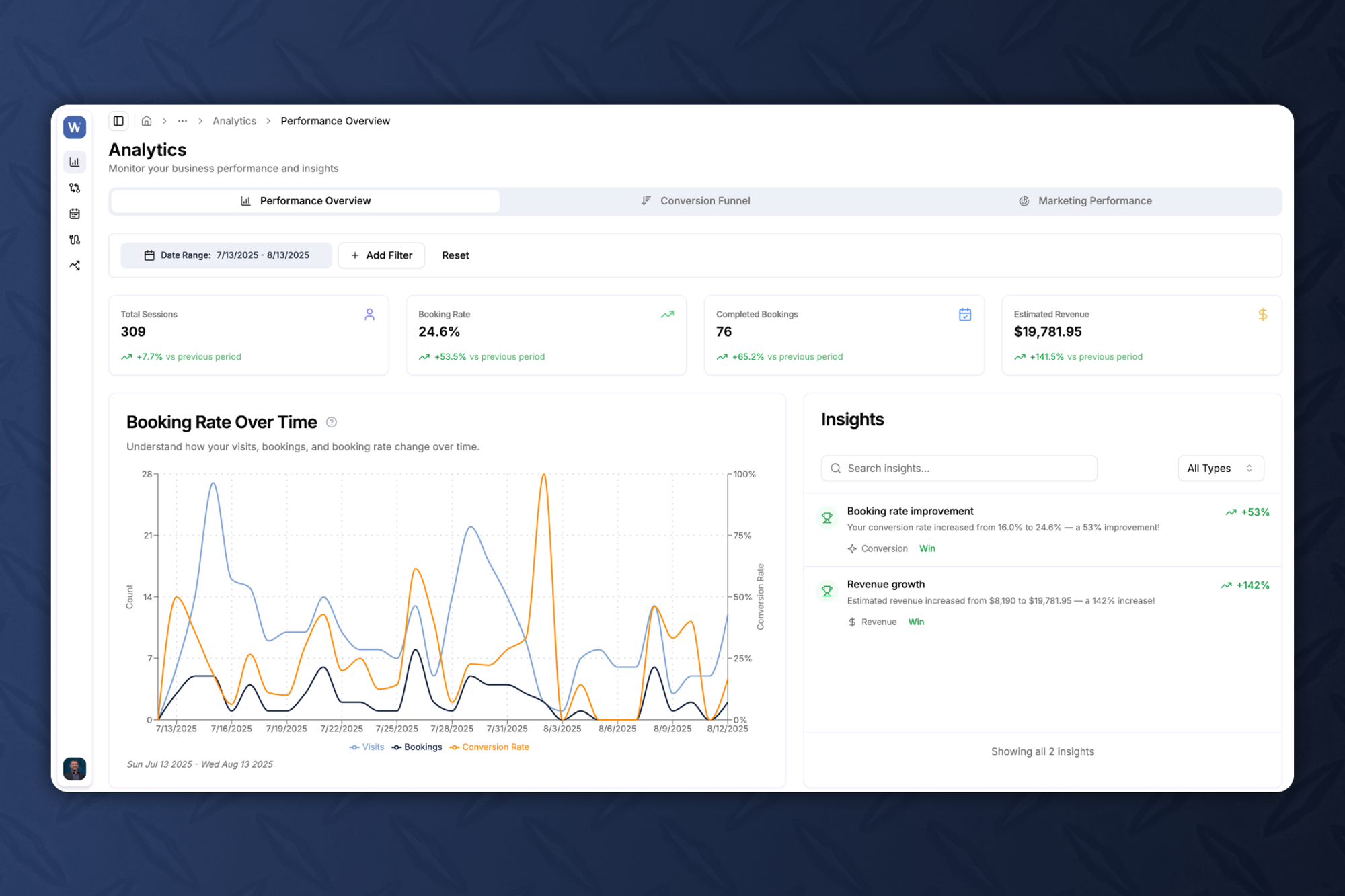
Turns out, the scheduling tools most trades businesses rely on have some... let's call them fundamental issues. Issues that cost real money. Like, a multi-service company in the Northeast—HVAC, electrical, plumbing, the works—switched to Wrkbelt and saw their booking conversion rate jump 53.5% within two months. Same marketing spend. Same website traffic. Just a different scheduler.
So yeah. We should probably talk about what's broken.
The Three Problems Nobody Talks About
Problem 1: Every Customer Gets the Same Experience
It's 2 AM. Someone's basement is flooding. They find your site, click "Book Now," and... wait, you're asking if they've used your service before? Whether they prefer morning or afternoon appointments? If they want to join your email list?
They have a fountain. In their basement. They've already called your competitor by question three.
Traditional schedulers treat emergency calls and routine maintenance inquiries identically—fifteen steps, same questions, same flow. It's the booking equivalent of making everyone wait in the same line at the ER regardless of whether they have a splinter or a heart attack.
Wrkbelt's solution: Unlimited, completely custom booking flows. Emergency path? Skip straight to time selection. Routine service? Ask the diagnostic questions. Premium membership renewal? Pre-fill everything and jump to scheduling. Each flow is built from the ground up—no templates, no compromises. You decide what customers see, when they see it, and why.
Problem 2: Your Marketing Data Disappears
You're spending—let's be conservative—five grand a month on Google Ads. Another few thousand on Facebook. UTM parameters everywhere. Tracking religiously.
Customer clicks your ad. Arrives at your site. Enters the scheduler. Completes the booking.
Where did they come from? Which campaign? Which keyword?
Your scheduler shrugs. "Website," it says helpfully. That's it. Six figures in annual marketing spend, and you're making decisions based on "probably Google?"
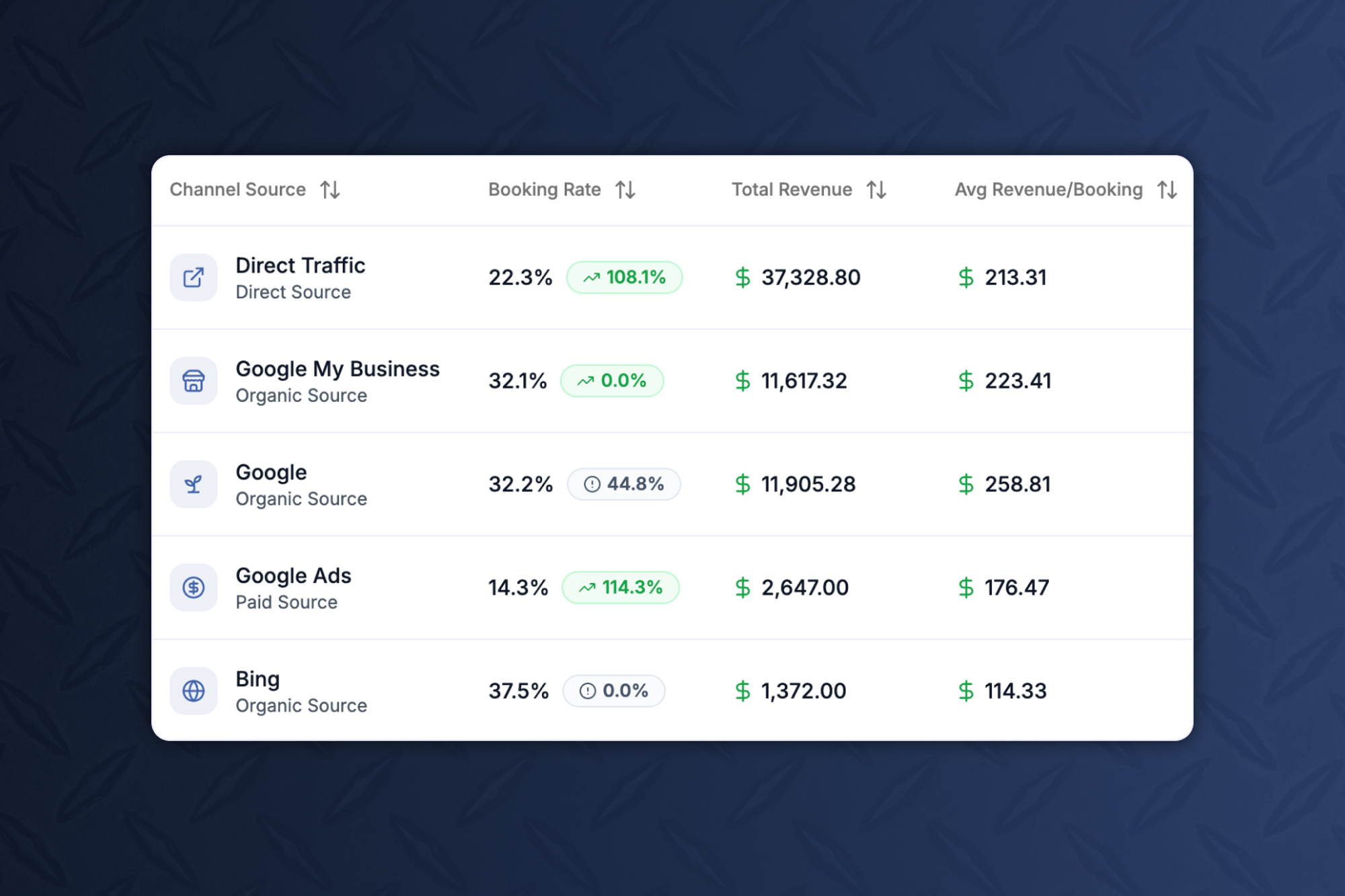
Wrkbelt's solution: Launch Context Recording captures everything—the full URL with UTM parameters, referral source, campaign data, device info, and here's where it gets interesting: custom marketing attribution. Working with 1SEO during beta taught us that agencies and savvy marketers track way beyond standard UTMs. So we built the ability to track any custom query parameters you're using. Campaign IDs, creative variants, audience segments—whatever you're measuring, we'll preserve it through to the final invoice.
Oh, and plot twist: we're already tracking AI/LLM traffic. As in, when ChatGPT or Perplexity sends someone your way. LLMO (LLM Optimization—basically SEO for AI) is coming whether you're ready or not. We are.
Problem 3: You're Reporting Fantasy Numbers
Your marketing dashboard says last month generated $47K in revenue. Fantastic! Time to increase ad spend.
Except that $47K? That's the estimate. The number your CSR punched in before your tech discovered the real problem, upsold the water heater replacement, and invoiced $68K.
Your analytics are off by 45%. Every ROI calculation? Wrong. Every budget decision? Based on fiction.
Wrkbelt's solution: Job Invoice Syncing (which wasn't even on our original roadmap—beta customers demanded it). We automatically sync with ServiceTitan every 12 hours for three months following each booking. Job completed? Scope changed? Upsells happened? We capture the actual invoiced amount. Every metric in your dashboard reflects real money that hit your bank account, not wishful thinking.
What Beta Actually Taught Us
Beyond the obvious problems we set out to solve, beta revealed some genuinely surprising insights:
Friction Kills Conversions (But You Knew That)
Less clicks is better. Duh, right? Except now we have the data to prove exactly how much better. Every unnecessary step costs you bookings—not in theory, in measurable percentages. One of our beta customers watched their conversion rate climb steadily as they stripped out irrelevant questions from high-intent flows. The correlation was almost comically direct.
Google My Business (Still) Prints Money
When we finally had clean attribution data, a pattern emerged that surprised exactly no one who's been in local service marketing: GMB and organic SEO consistently outperform most paid channels on ROI. Not volume—ROI. People finding you organically tend to book higher-value jobs. This might seem obvious, but most businesses have never actually seen the data because their scheduler can't tell them.
Service Demand Varies Wildly by Channel
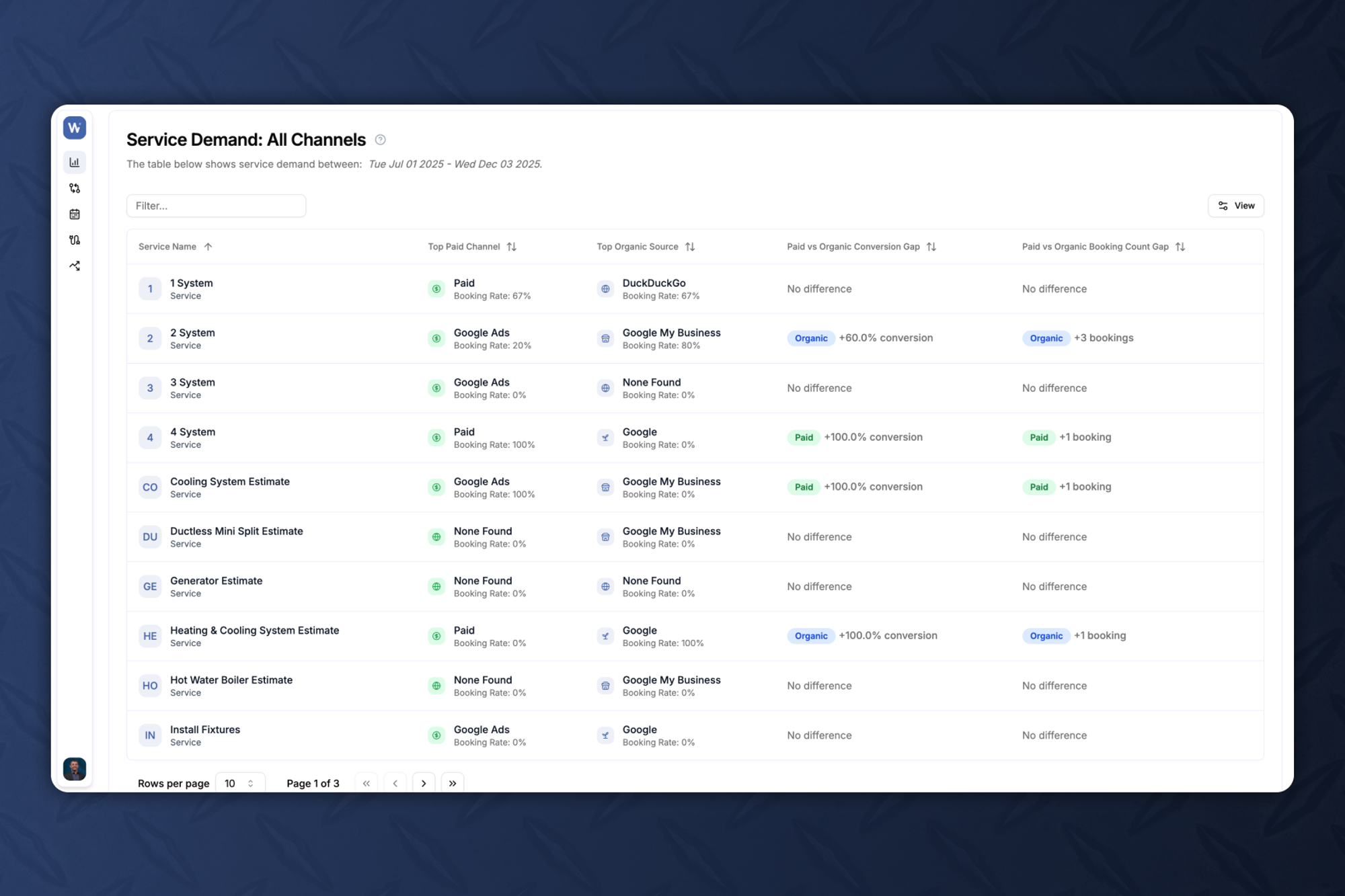
Here's where it gets tactical. With granular service-level analytics by marketing channel, you can see which services people search for versus which they respond to in paid ads versus which they book through social. Emergency HVAC? Google dominates. Preventive maintenance? Email campaigns win. Premium installations? Facebook's your channel.
This kind of intelligence lets marketers optimize creative, landing pages, and budget allocation with surgical precision. One beta customer restructured their entire content strategy after discovering their SEO traffic was booking completely different services than their paid traffic.
AI Traffic Is Already Here
We started seeing traffic from ChatGPT, Perplexity, and other LLMs showing up in our attribution data. Not a ton yet—but enough to notice. LLMO (LLM Optimization) is going to be a thing. Maybe already is. Good news: Wrkbelt tracks it automatically, so when this traffic becomes significant, you'll know where it's coming from and what it's worth.
Stop guessing which campaigns actually work
See exactly where your bookings come from and what they're really worth. Schedule a demo and we'll show you what you've been missing.
What Makes Wrkbelt Different
Look, I've seen enough "revolutionary" products that are just the same thing with different branding. So let me be direct:
Complete composability. This isn't a template system. You build booking flows from scratch—question by question, step by step, branch by branch. Want to show different options based on zip code? Sure. Want to skip steps for returning customers? Easy. Want to create fifteen different flows for fifteen different campaigns? Go wild.
Real attribution. Not "probably Google" attribution. Granular, campaign-level tracking that survives the entire booking journey and ties directly to actual revenue. Plus custom parameter support for sophisticated marketers who track beyond standard UTMs.
Actual revenue tracking. Continuous invoice syncing for three months after every booking. Your analytics update automatically as jobs complete, change scope, generate upsells. No manual exports. No spreadsheet gymnastics. Just real financial intelligence.
Built for trades businesses. We're not trying to be everything to everyone. Wrkbelt is purpose-built for service companies using ServiceTitan. Deep integration, dispatch awareness, understanding that jobs change scope. This specificity isn't a limitation—it's why the thing actually works.
Who This Is For
Service businesses using ServiceTitan who spend real money on marketing and want to know what's working. Companies doing $5M+ annually where these problems actually cost significant revenue.
Marketing teams and agencies tired of proving ROI with proxy metrics and incomplete data. Especially ServiceTitan partner agencies looking to differentiate and deliver measurable results.
Operations leaders who know their booking process is bleeding opportunities but haven't had tools to fix it without breaking everything.
If you're a solo operator doing $500K annually, Wrkbelt might be overkill. Yet. But if you're scaling, spending on marketing, and asking "which campaigns actually make us money?" without getting clear answers... yeah, we built this for you.
What Happens Next
Wrkbelt Scheduler is available now. Setup takes about an hour. We provide a deployment script, you drop it on your site, configure your flows, and you're live. No developer required. No weeks-long implementation. No consultant fees.
For ServiceTitan users, integration is plug-and-play. Job types sync automatically. Availability updates in real-time. Customer data flows bidirectionally. Invoice updates happen continuously.
We offer live demos—actual demos, not recorded presentations—where we walk through the platform and show you how it solves your specific problems. No pitch. No pressure.
We also have a 30-day pilot program for agencies interested in testing with clients. Full access, white-glove support, co-marketing opportunities if things go well.
One More Thing
Building Wrkbelt reinforced something our engineering team already knew: the best software emerges from tight feedback loops with actual users. Not from guessing what they might need in a conference room.
Our team—engineers with years of experience from cutting-edge tech companies—deliberately approached this as an iterative build. Ship something. Watch how people use it. Learn what actually matters. Refine ruthlessly. It's human-centered design 101, but you'd be surprised how many products skip this part.
Take the invoice syncing system. We architected three different versions during beta—not because the first two were broken, but because each iteration with real customers revealed nuances we couldn't have anticipated. Rate limiting strategies that worked in testing behaved differently at scale. Edge cases that seemed theoretical turned out to be... well, not that theoretical. Having the engineering chops to pivot quickly when user needs crystallized? That's what separated this from being another half-baked integration.
Over the coming weeks, I'll share deeper dives into what we learned. Topics on deck: why we rebuilt the invoice syncing architecture three times (and how each version solved different real-world problems), why LLMO matters sooner than you think, how we designed the booking flow builder to handle infinite complexity without becoming unusable, and why that premium Northeast service company saw a 53% lift while others saw 30-45%—spoiler: it's about how they structured their flows, informed by data we helped them see for the first time.
For now, if your scheduler is costing you bookings—and after seven months of beta with real businesses, I can confidently say most are—let's fix that.
Sean
CEO, Wrkbelt
P.S. - If you made it this far, you're probably someone who appreciates software built thoughtfully rather than quickly. We should definitely talk.